Gramsci and Global Politics by McNally Mark & Schwarzmantel John
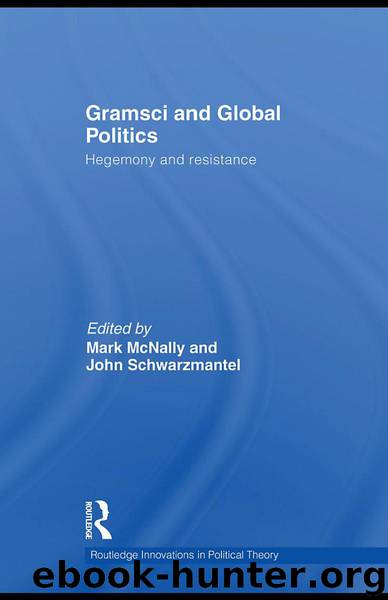
Author:McNally, Mark & Schwarzmantel, John [Mark, McNally, & John, Schwarzmantel,]
Format: epub
Tags: Humanities
Published: 2010-03-19T21:58:27+00:00
Part III
Gramsci and contemporary
British politics
10 Prince of modernisers
Gramsci, New Labour and the meaning
of modernity
Will Leggett
Introduction
During the 1980s neo-Gramscian thinking, pioneered by Stuart Hall, was central to the British Left coming to terms with Thatcherism. It is therefore no surprise that analysis of New Labour has similarly been haunted by Gramsci’s thought. In addition to the burgeoning mainstream political science and social policy literature, there has been a distinctively neo-Gramscian body of work that has attempted to understand the New Labour project. This has again been led by Hall (1998; 2003), complemented by others working in a similar vein (Finlayson 2003; Leggett 2005; Newman 2001; Bewes and Gilbert 2000; Coddington and Perryman 1998; Hassan 2007; Steinberg and Johnson, 2004c). After more than a decade of New Labour in power – and at a time of writing (summer 2008) when the project appears to be in terminal decline – this chapter considers what Gramscian thinking has contributed to understanding the complex New Labour phenomenon, as well as possible paths beyond it. At the same time, it also asks what analysis of New Labour tells us about the continuing relevance of Gramsci’s thought. In so doing, there is of course a risk of simply going through a ‘shopping list’ of Gramscian concepts in a manner that does violence to his original context and intent. However, in this I follow Hall, who cautions that ‘I do not claim that, in any simple way, Gramsci “has the answers” or “holds the key” to our present troubles. I do believe that we must “think” our problems in a Gramscian way – which is different’ (Hall 1987: 16). It is precisely the richness and attempting to capture live political projects; it is worth pushing some of his ideas a little – even if this does depart from their original deployment – to see what they can do for us today.
Gramsci’s analysis of the economic and social revolutions he was witnessing, and New Labour’s reading of late modernity. Using a range of Gramsci’s concepts (italicised here), it is argued that far from being just ‘spin’, the New Labour project was authentically hegemonic in intent. While the pragmatic and tactical –
conjunctural – context needs to be fully recognised, New Labour sought to win a battle of ideas and instil a new political 138 W. Leggett
common sense. In the form of the Third Way, this was based on a fundamental –
organic – reading of rapid social, economic and cultural change, and its political implications. New Labour attempted intellectual and moral leadership in trying to instil this common sense and construct a ‘ collective man’ for a new era. Despite New Labour’s potentially Gramscian aspects, the politics of the project have been a bitter disappointment to progressives. The second section thus explores neo-Gramscian accounts of the political character of New Labour, and here some of the relative strengths and limitations of Gramscian analysis come into sharper focus. Much has been made of the concepts of transformism and passive revolution in understanding New Labour as a vehicle for neoliberalism.
Download
This site does not store any files on its server. We only index and link to content provided by other sites. Please contact the content providers to delete copyright contents if any and email us, we'll remove relevant links or contents immediately.
| Elections & Political Process | Ideologies & Doctrines |
| International & World Politics | Political Science |
| Public Affairs & Policy | Specific Topics |
| United States |
The Secret History by Donna Tartt(18994)
The Social Justice Warrior Handbook by Lisa De Pasquale(12175)
Thirteen Reasons Why by Jay Asher(8871)
This Is How You Lose Her by Junot Diaz(6854)
Weapons of Math Destruction by Cathy O'Neil(6246)
Zero to One by Peter Thiel(5760)
Beartown by Fredrik Backman(5706)
The Myth of the Strong Leader by Archie Brown(5479)
The Fire Next Time by James Baldwin(5408)
How Democracies Die by Steven Levitsky & Daniel Ziblatt(5198)
Promise Me, Dad by Joe Biden(5127)
Stone's Rules by Roger Stone(5065)
A Higher Loyalty: Truth, Lies, and Leadership by James Comey(4937)
100 Deadly Skills by Clint Emerson(4898)
Rise and Kill First by Ronen Bergman(4757)
Secrecy World by Jake Bernstein(4724)
The David Icke Guide to the Global Conspiracy (and how to end it) by David Icke(4680)
The Farm by Tom Rob Smith(4484)
The Doomsday Machine by Daniel Ellsberg(4472)
